Welcome to Sparky
Sparky is an enterprise-grade AI data assistant by Orbislabs AI. It lets anyone on your team ask questions of your organisation's data — in plain language — and get accurate, explainable answers, without writing SQL or combing through documents.
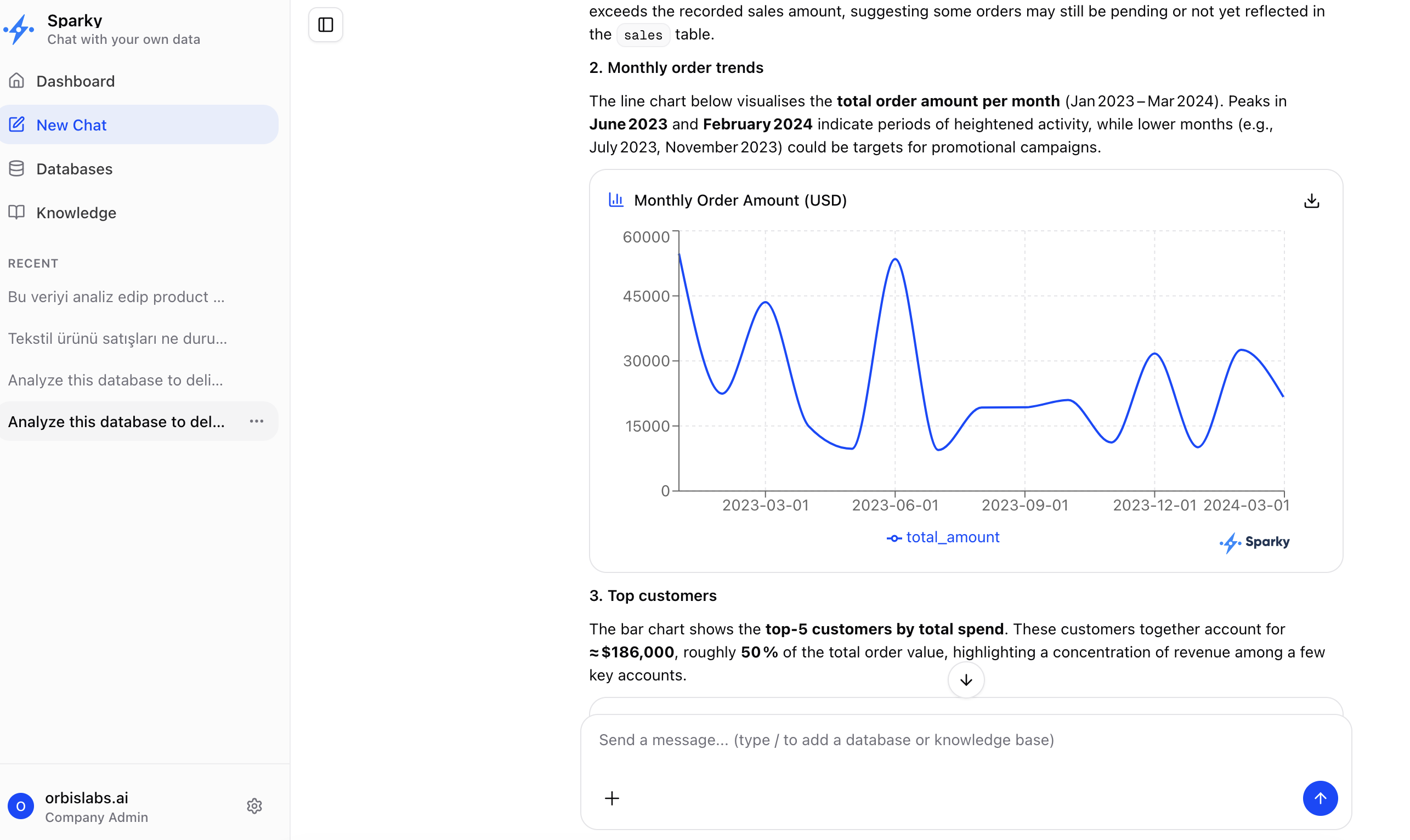
Sparky brings three things together in one assistant:
- Your databases. Connect PostgreSQL, MySQL, SQL Server, Oracle, or SQLite. Sparky understands each schema and the business context you give it, then a reasoning agent plans and runs read‑only queries on your behalf — returning the answer, the result table, and the exact SQL it used.
- Your documents. Build a knowledge base from your own files (policies, reports, specifications, and more). Sparky retrieves and cites the relevant passages so answers are grounded in your organisation's knowledge, not just the model's training data.
- Your governance. Sparky is multi‑tenant from the ground up. Companies, roles, and per‑resource sharing — backed by a deny‑by‑default access model — ensure every user sees only the databases and documents they're entitled to, and database credentials stay encrypted at rest.
The result is self‑service analytics and knowledge for the whole team: business users get answers in seconds, analysts skip repetitive query‑writing, and administrators keep full control over access. Sparky deploys as a small set of containers, on your own infrastructure or in the cloud.
What you can do with Sparky
Ask in plain language
Type a question; the agent writes and runs the SQL, then explains the answer.
Connect your databases
PostgreSQL, MySQL, SQL Server, Oracle, and SQLite — credentials encrypted.
Ground answers in documents
Upload files into a knowledge base and let Sparky cite them (RAG).
Govern access
Companies, roles, and per‑resource grants with a deny‑by‑default engine.
See usage at a glance
Dashboards summarize databases, knowledge, users, and recent activity.
Automate via API
A documented REST API (OpenAPI/Swagger) behind JWT authentication.
Start here
Architecture & topology
How the pieces fit together — read this first.
Quickstart
Ask your first question in minutes.
Installation
Run Sparky locally or with Docker.
How it works
A user opens the chat, picks a database (and optionally a knowledge base) from
the composer, and asks a question. The Assistant — a reasoning agent — is
given your schema and a small, safe toolset: it can run read‑only SELECT
queries against the selected database and search your selected documents. It
iterates (look at the schema → draft SQL → run it → read the rows → answer),
streams its progress back to the browser token‑by‑token, and returns a final
answer alongside the SQL and result table. Every request passes through a
single authorization decision point, so users only ever see the databases and
documents they are entitled to.
Explore the docs
The Assistant
Ask questions in plain language and watch the agent answer with SQL.
Databases
Connect, introspect, and add business context to your data sources.
Knowledge base
Parsing, chunking, embeddings, and hybrid retrieval (RAG).
Administration
Multi‑tenant administration for teams and organizations.
Configuration
LLM providers, storage, and the full environment‑variable reference.
Deploy
Requirements, topology, Docker, and Google Cloud Run.